
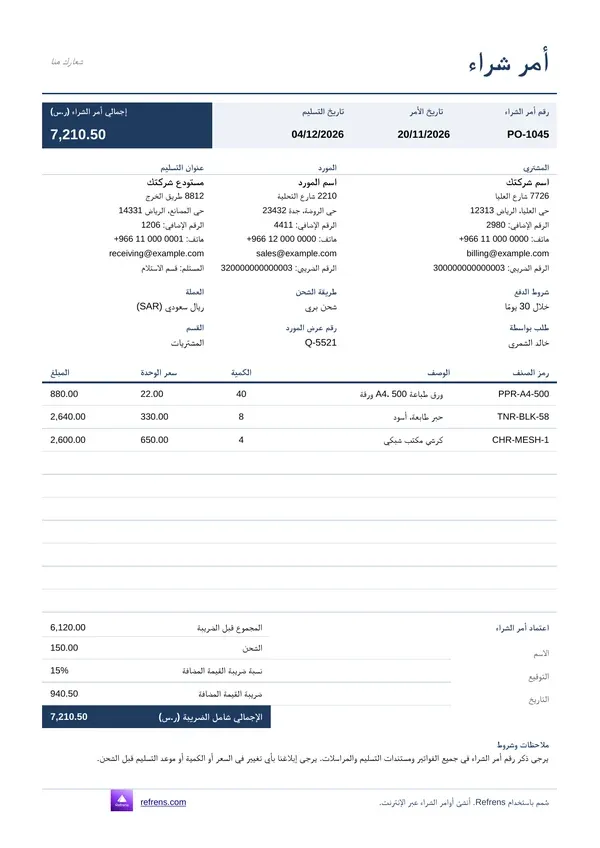
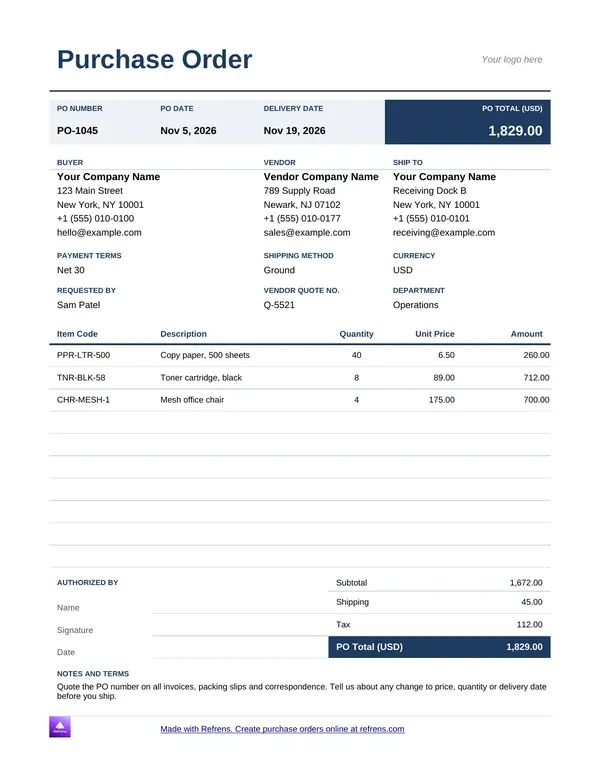
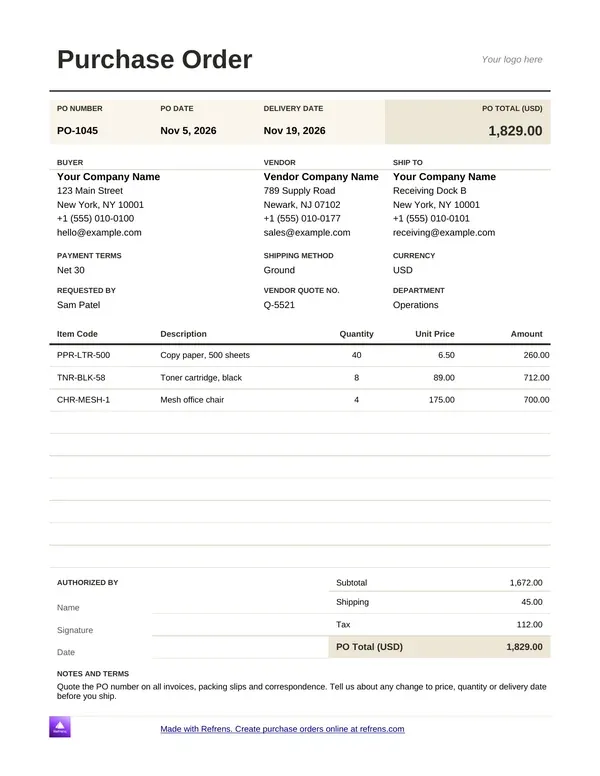
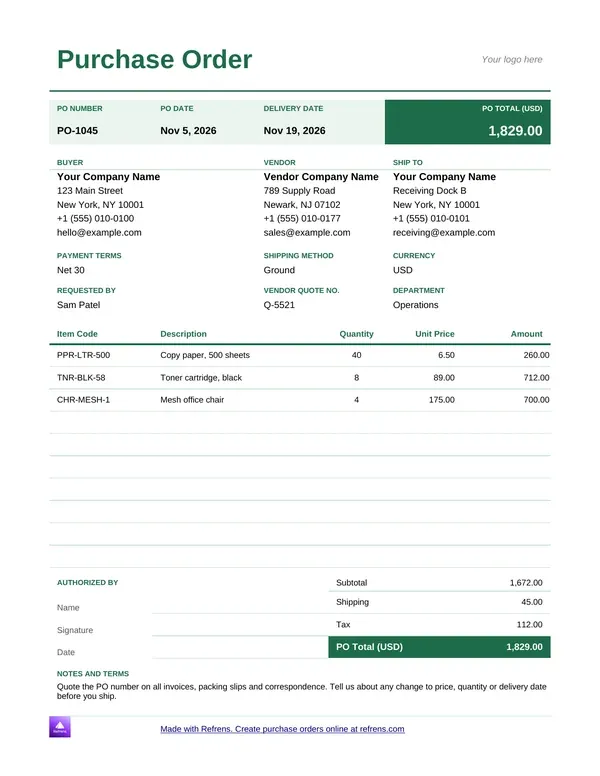
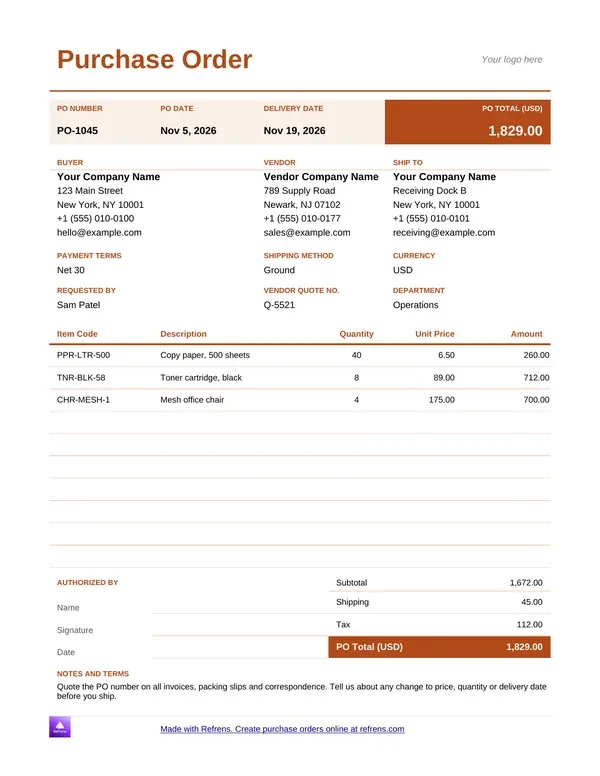
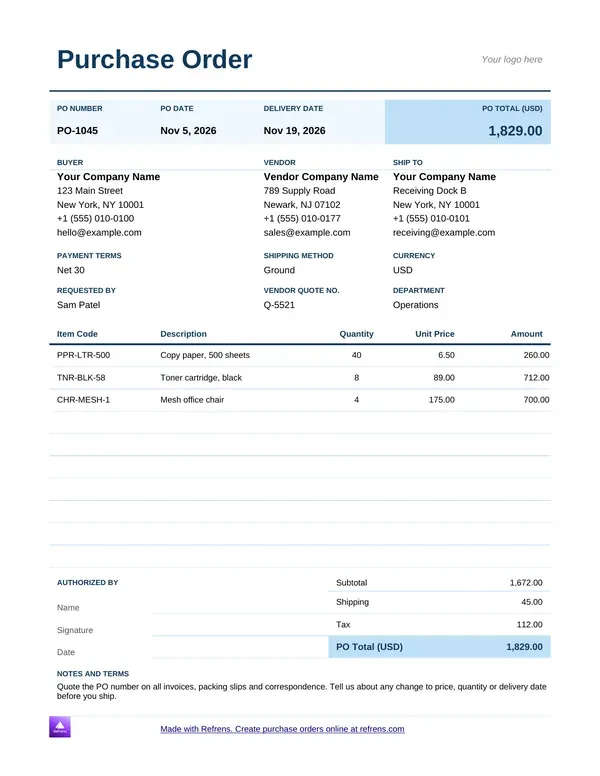
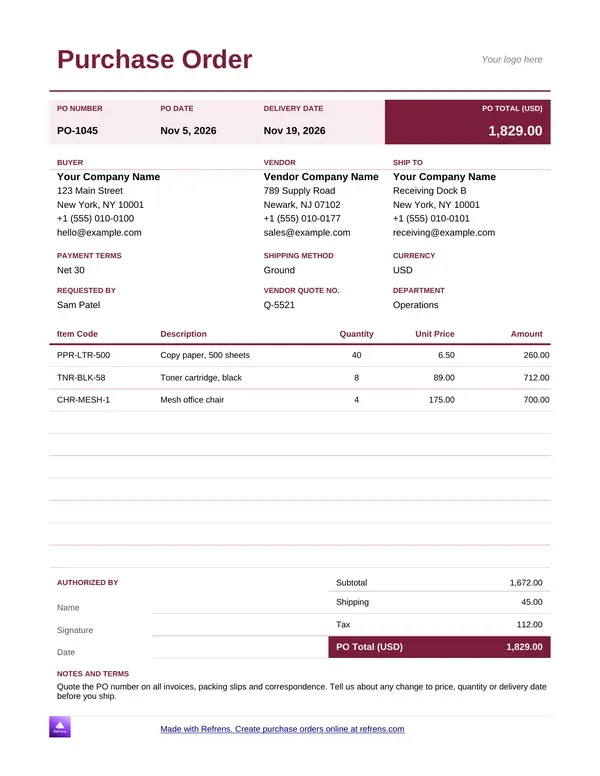
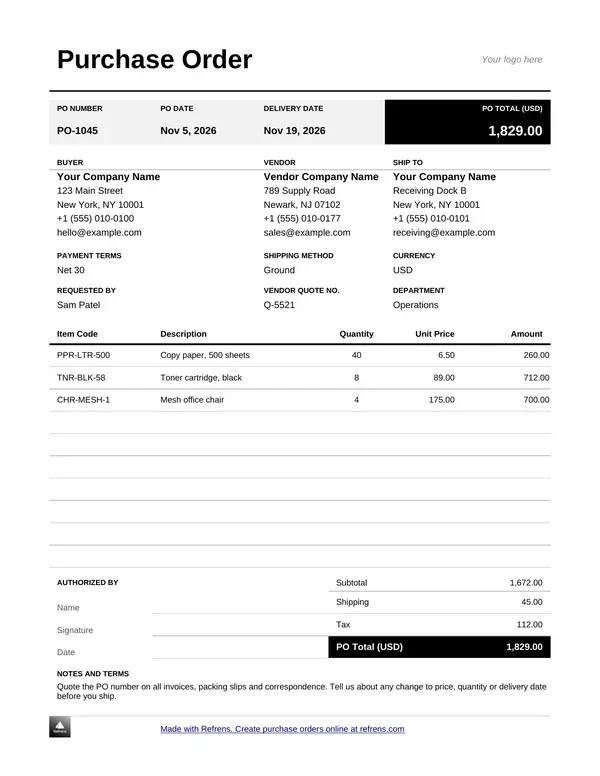
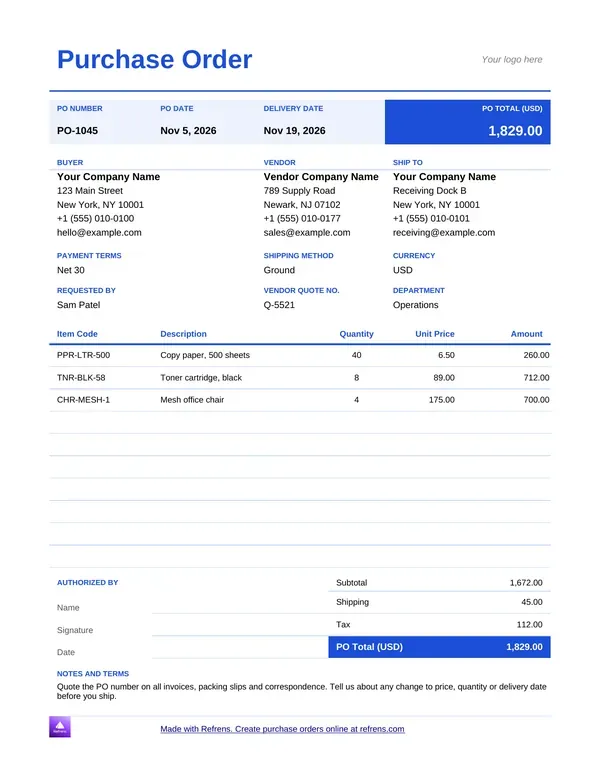
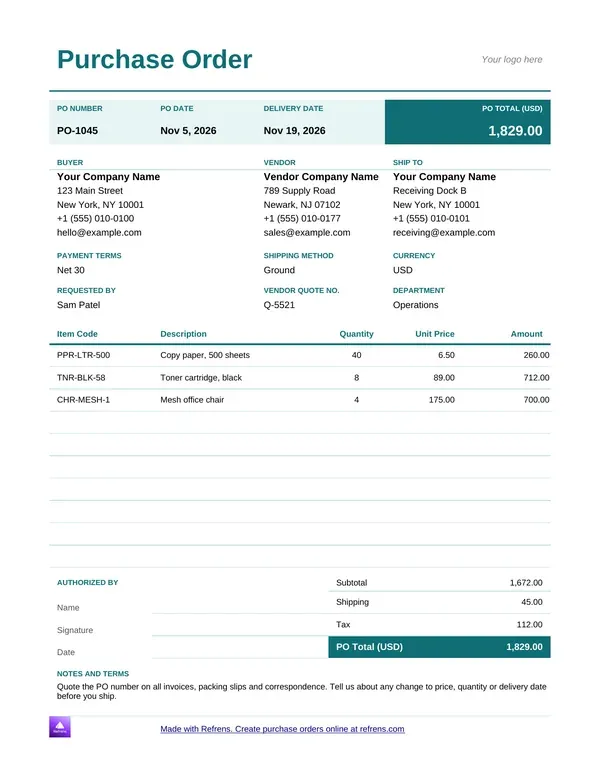
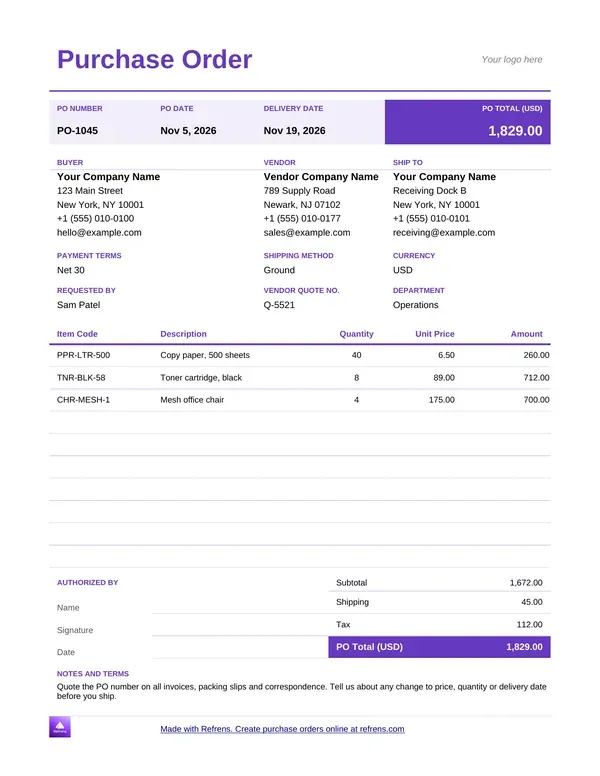
A purchase order template gets an order to your supplier in minutes. It fixes the items, prices and delivery date before anything ships. It works while you place a few orders. It stops working when orders, approvers and deliveries multiply. This page gives you Word and Excel files in English and Arabic, a Saudi format, a worked SAR example with 15% VAT, and answers to the tax questions buyers ask.
Pick the file that matches how you edit and who reads the order.
A purchase order is a buyer's written order to a supplier. It lists the items, quantities, prices and delivery terms the buyer agrees to pay for. A purchase order is not a tax invoice.
Four documents run in a fixed order, and each side issues different ones.
You issue the purchase order. The supplier issues the other three.
The VAT rules set a layout for tax invoices, not for purchase orders, so these fields are good practice. Each one carries the mistake it prevents.
Your PO number does one job at matching. It ties the supplier's tax invoice to your order. Ask the supplier to print it on the invoice.
Word and Excel cover most Saudi buyers, and the choice comes down to how many lines you order.
A Word purchase order suits a short order with long terms. Word does not calculate totals unless you build the formula, so check the arithmetic by hand. Send the order as a PDF so the supplier cannot edit it.
An Excel purchase order suits many lines. Build four formulas and the totals update as you type. In a sheet with quantity in column C and unit price in column D:
=C2*D2=SUM(E2:E20)=ROUND((E21-E22)*0.15,2), where E22 holds the discount in SAR=E21-E22+E23Lock the formula cells. Save one file per PO and name it with the PO number. Change the PO number before you reuse a file.
The Arabic Word and Excel templates serve buyers and suppliers who work in Arabic. Download the Arabic Word file for a text-heavy order. Download the Arabic Excel file for many lines.
Agree the language of the order with your supplier. Use Arabic when your supplier works in Arabic, and keep the item names identical to the quotation. Your supplier can also issue its Arabic tax invoice with a QR code from إنشاء فاتورة برمز QR, the Arabic invoice generator.
You make a PO in five steps: get a quotation, check it, fill in the format, get approval, and send it.
A template is a file you fill in. A purchase order generator numbers the order, saves it and shares it for you. Use a template for one-off orders. Use a generator when you place orders every week.
A fit-out contractor in Dammam orders SAR 16,230 of electrical items, and a SAR 3 price change on one line shows why the PO matters. This example is illustrative. It is not a real customer.
The purchase order:
The supplier delivers in two parts. The first delivery holds the boards, the breakers and the delivery charge. The cable drums come later.
The first invoice should read SAR 8,700 + SAR 2,480 + SAR 350 = SAR 11,530. VAT at 15% is SAR 1,729.50. The total is SAR 13,259.50.
The supplier's first tax invoice bills the breakers at SAR 65, not SAR 62. That line becomes SAR 2,600. The invoice subtotal is SAR 11,650. VAT is SAR 1,747.50. The total is SAR 13,397.50. The invoice is SAR 120 higher before VAT, SAR 18 higher in VAT and SAR 138 higher in total. You catch the change because the PO sits next to the invoice.
The second delivery is 5 cable drums at SAR 940, which is SAR 4,700. VAT is SAR 705. The total is SAR 5,405. The two correct invoices add up to SAR 13,259.50 + SAR 5,405 = SAR 18,664.50. That equals the PO total.
Most Saudi buyers use one of five order types, and each type needs different fields.
A goods PO suits trading, wholesale and distribution. Focus on item codes, units, quantities and delivery dates.
A service PO suits consultants, agencies and KIBS firms. Replace items with a scope, a rate and milestones.
A contractor PO lists the item or phase, the quantity, the rate, what the order leaves out, and the site for delivery. Add the milestone that triggers each payment.
A blanket PO covers one agreed supply over a period, with separate releases. It fits repeat orders from the same supplier at an agreed price.
A simple PO is a one-page order for a small purchase. Buyers in the Gulf also call it a local purchase order, or LPO.
A purchase order is not a tax invoice, and it does not support an input VAT claim. Three points follow.
ZATCA e-invoicing applies to the invoices you issue as a seller. Refrens supports ZATCA Phase 1 and Phase 2 for those invoices. See e-invoicing software in Saudi Arabia for how it works.
ZATCA announced Wave 25 on 24 Jul 2026. It targets taxpayers whose VAT-subject revenue passed SAR 187,500 in any year from 2022 to 2025. Integration is due by 1 Feb 2027, after ZATCA notifies the taxpayer.
A template is the right choice when you place few orders and one person approves them.
A template stops being enough when more people, deliveries or currencies touch the same order.
After delivery, you check three documents against your PO: the delivery note, the supplier's tax invoice, and the PO. Use the delivery note template to record what arrived. Sellers who must issue the tax invoice can use the invoice maker.
Then you record the supplier's invoice as a purchase bill. There are three paths:
The retyping happens with any tool that keeps the PO outside your accounting system. In the example above, the first invoice has three lines. You type all three, plus the supplier, the date and the PO number, and then you compare them with a PO in another file.
You make a purchase order online by filling in the form, signing up and getting your PO. Your first 15 documents are free.
The online form covers what a file cannot:
A PO made in Refrens converts into a purchase bill. You compare lines instead of typing them. Keep your purchase bills, input VAT and records in one place with cloud accounting software in KSA. Issue your own tax invoices with free invoicing software. If you also sell, free quoting software turns your quotes into orders.
Button: Create purchase order online
These answers give general information. They are not tax or legal advice. Ask your tax adviser or lawyer before you rely on them.
No. A purchase order is the buyer's order. The tax invoice comes from the supplier and carries the VAT. ZATCA defines the tax invoice and the simplified tax invoice as the VAT documents.
No. A VAT-registered buyer claims input VAT with the supplier's tax invoice or a customs document. A purchase order is neither.
It can show the expected VAT at 15% as an estimate. The supplier's tax invoice states the final VAT. Show prices before VAT and add a VAT line, or state that prices include VAT.
No. A purchase order is not a tax invoice, so it carries no ZATCA QR code and needs no clearance. The tax invoices you issue as a seller do.
It can be. A supplier's quotation is an offer. A PO that matches it works as an acceptance, and the contract forms. A PO that changes the price, quantity or terms is a new offer, and the supplier's confirmation completes the contract. Silence is not acceptance. The Civil Transactions Law sets the rules on offer and acceptance in Articles 31, 36 and 37. Ask a lawyer how they apply to your order.
Before the supplier accepts, you can withdraw it. If the order sets no period, notify the supplier. Otherwise you may owe compensation, excluding lost profit. After the supplier accepts, you change or cancel the order by agreement, unless the law allows otherwise. Ask a lawyer about your order.
Yes. A supplier issues a tax invoice for an advance within 15 days after the end of the month in which it received the money. Ask for it. You need it for your input VAT.
Yes. Ask the supplier to include it, because it lets you match the invoice to the order. ZATCA's sample tax invoices show a purchase order number among their other information.
Different VAT rules apply. Imported goods carry 15% import VAT, which the importer pays at customs. Services from a supplier outside the Kingdom fall under the reverse charge. Withholding tax can apply, and the rate depends on the payment type. List goods and services on separate PO lines.
No Saudi rule requires you to number or keep purchase orders as such. Invoices, books and records must be kept for at least six years from the end of the related tax period. Keep each PO with the matching supplier invoice.
Use Excel when your order has many lines and you want the totals to calculate. Use Word when your order is short and the terms are long. Both come in English and Arabic.
Yes. The Word and Excel templates are free to download. If you make a PO online, your first 15 documents are free. After that, you move to a paid plan.
Yes. Edit the Word and Excel files in Word or Excel. Lock the formula cells in Excel, and send the order to your supplier as a PDF.
Yes. Download the Arabic Word or Excel template, or make the PO online with Arabic output. Agree the language with your supplier and keep item names identical to the quotation.
Use your own series, such as PO-2026-0001, and never reuse a number. Saudi VAT rules require sequential numbers on tax invoices, not on purchase orders, so the series is your control. Give each order one number and print it on the supplier's invoice.
A quotation is the supplier's offer. A purchase order is your written order that accepts the offer or changes it. The quotation comes first.
Send the PO as a PDF by email or WhatsApp, and keep a copy with the quotation. In Refrens, you share the PO by email or WhatsApp and see when the supplier has seen it.
A template is a file you fill in and number yourself. A generator numbers the order, saves it, shares it and tracks its status.
Yes. Refrens stores your data with encryption and cloud protection. We are ISO/IEC 27001:2022 certified. Your data stays private.
Pick the purchase order template that fits your next order. When orders, approvers and deliveries multiply, make the PO online instead. See what else Refrens offers Saudi businesses at Refrens Saudi Arabia.